Saturday, 4 February 2012

The Road to Wau, part 2


Public transport to Wau again. I re-iterate that I like public transport in South Sudan, I could fly, but I don’t enjoy it as much. Having said that yesterday’s journey had some highlights that made me wish I was safely strapped into a UN/WFP plane.

We went to the bus stop in Rumbek early, too early it turned out, no one was there. The two friends I was with did some negotiation on my behalf to get me (1) in a good seat, (2) in a good car  and (3) with a driver they trust (i.e. someone they know). Unfortunately this was not the first car going and meant a 4 hour wait for the car to fill up with passengers.

The other passengers were a woman who was returning from accompanying her mother to Rumbek and 2 young men going to visit family in Wau. We were short of passengers for what seemed like forever. Just as I was beginning to give up hope that we would ever leave, our party was made up by 2 armed policemen, one of whom had been shot in the arm in Rumbek North they day before (its not in the news yet, but the clashed in Tonj East have spread to Rumbek North). He was going home to Wau where his family would take care of him.

The injured policeman was drinking local alcohol. Under the circumstances (having been shot with apparently given no more medical treatment than a bandage) this seemed understandable, and perhaps the most reasonable thing to be doing. However, sitting in a car with drunk armed men is never a good feeling. And it did mean an extended stop at every police checkpoint while they explained to their colleagues what had happened

Then somewhere between Cuiebet and Tonj something underneath the car fell off. (Things going wrong with cars on these dirt roads is quite common). The drivers had whatever kit they needed to patch up the problem (i.e. tie whatever had fallen off back on) and we continued to Tonj.

In Tonj we stopped for an inordinately long period of time for food and sisha. The bus stops in Tonj at a little eatery where street boys and others come and try and get a few pounds of travellers and eat their left over lunch.

We listened to music and everyone sang along, there was a particularly energetic performance to Beyonce’s ‘I Need a Soldier”. Sugar cane was passed round and lots of chatting

A few hours later we reached Wau…dropped the policeman with a bullet wound with some relatives and then I was dropped at my ‘home’ for the next few days. The driver and his friend asked if they could meet me later. I gave them a polite but emphatic, ‘no’ and went to wash the dust off myself. 

Sunday, 6 November 2011

Missionary Moorings


I am now coming to you from Kuajok, Warrap State. Apologies for the long absence in blogging, which has been due in a large part to irregular access to power. Since my beloved MacBook battery is on its last legs, writing updates without power has been very difficult. Now I see why blogging is a luxury of the urban middle class. 

Kuajok is the capital of Warrap State. The first two things that anyone will tell you when you arrive in Kuajok is that (1) it is a very new town and (2) it has been very well surveyed. The latter is certainly true. The roads are so straight it would break the Romans’ hearts to see them. The first thing is technically true – as a ‘town’ Kuajok is new, but it was a mission, schools and was a large village since 1923. President Kiir himself went to secondary school in Kuajok and when he came on an official visit last week, leaned up to the window of his car and shot a special “thumbs up” to the group of secondary school students lined up in their uniform to greet him (much to their delight).

In my first few weeks here I have been told a lot about the arrival of the missionaries and establishing Kuajok as a centre. On Wednesday evening I was taken on a walk to the river port where the missionaries landed (Wanh Abun). At this time of year the river is about an hours walk away, over toic (flood plain), its still quite wet and walking is the only way to get there.

On the way we met several groups of people heading back to their home villages across the river after having sold milk, maize in Kuajok market or having just been visiting. My Dinka language – although still very limited – is now at the stage where I can have a small conversation, introduce and explain myself to people.

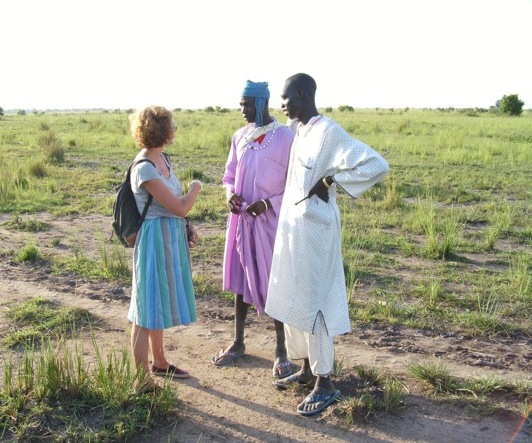
These two young men were walking to a cattle camp about 4 hours away, but they explained that they were strong and they would run so it would only take them 2. Young men frequently like to point out to me how strong they are and tell me how weak I am (as a foreign girl).


When we got to the river they swam across it (instead of taking the small boat) after telling me I would never be able to make it, despite my protestations that I do know how to swim!


At the river bank, to the left of the boats currently used my commuters is ‘Wanh Abun.’ Essentially a bank, the only thing that marks it out is the 6 or 7 metal posts that were once used to moor the missionaries boats. One of them has been pulled out of the ground and you can see the cast mark of a London company “Siemens”. There is also the remains of a brick structure which an old lady told me was the house of an missionary. To me it looked too small and too close to the river to be a house, more likely a store room connected with the mooring of the boats or a place to rest and unload 

The remains of the "missionary's house"
detail of the uprooted mooring post

Tuesday, 11 October 2011

The road to Wau


I like travelling by road. You see more, you stop in interesting places and you meet and talk to fellow travelers (because you are bumping along with them in an intimate fashion for hours and hours). Road travel gives me more of an illusion of safety, because I am not thousands of miles above the air in a metal shell. Although I realise it is the least safe way to travel.

I have found road travel and the condition of roads is also a hot topic of conversation in South Sudanese towns. This is partly because people in towns use roads frequently to visit family in rural areas. And because the condition of these roads (security and general maintenance) has very real effects on daily life. South Sudan is a major importer of food and commodities rather than a producer, so if the main roads are bad, supplies drop and prices rise noticeably. The road connecting Rumbek to Juba (via Yirol) is a prime example. This road goes through very low land and is in a bad condition. This means that in the wet season fuel and food doesn’t reach Rumbek (and Wau and other places) as well as it should.

I recently took the road from Rumbek (in Lakes State) to Wau (In Western Bahr el Ghazal State).  This road is actually good, for the most part. The journey took 6 hours. From Rumbek to Mapel the road in is good condition. Mapel, an important SPLA barracks is over half way and you reach it in 3 hours. The last 3 hours, although a shorter distance, to longer to cover on account of mud and potholes.

The major landmarks on the way are Cuiebet – a small town about an hour from Rumbek. The road then goes through a big wet season grazing area, on the border between Lakes and Warrap. Here there are currently thousands of cattle visible from the road, being taken through pasture submerged in water. Cattle and people up to their knees in flood. Cattle keepers were walking the herds on the road to avoid the flood, much to the irritation of everyone else in the car.

Leaving Lakes State you soon reach Tonj and stop for lunch and pass through vehicle checkpoints.

We made a further stop at the turning for Mapel to unload food (for the army? I wasn’t sure)

Then uninterrupted driving till we reach the outskirts of Wau and passed through another checkpoint to check foreigners ID.

Arrived in Wau at about 3pm

Sunday, 9 October 2011

Picture post - wet season cattle camp

A few weeks before leaving Rumbek I went with a friend to visit some of his family and cattle just outside Cueibet.

We walked from the village, its normally about half an hour. But it had rained the night before and the path was completely underwater so it took us just over an hour (also may have had something to do with my pace being slighting on the slower than average).

Still it wasn't a long walk, other than vegetation, the only thing we passed on the way were some old homesteads - places where people had lived during the war when it was unsafe to be in Cuiebet and near the road. There are just wooden supports of vanished tukuls remaining now. People have moved back, or on somewhere else

People and cattle had arrived at the cattle camp only a few days before, so everything was still really green and lush. It was beautiful

I'm now in Wau, about to move on to Kuajok. But first I wanted to take advantage of a good internet connection and power to put a few photos.


Wednesday, 7 September 2011

A Working Guide to Graves in Lakes State.


This is a bit out there.  I am have a blossoming interesting in graves in and around Rumbek and I want to indulge it. This could just be morbid curiosity but think this came from a wider interest in the architecture and built environment of Rumbek. Grave stones, being solid stone, survive better than a lot of other things.

The graves of big men come in all shapes and sizes. Go to Maper in Rumbek North County and you can see the grave of Wol Athiang, a famous chief of the Pakkam subsection of Agar Dinka. There is no grave stone, it is a tree with posts where cattle had been tethered before being sacrificed. (See a photo). For something more flash, on Freedom Square in Rumbek, there is the grave of Gordon Muortat a prominent southern politician. This is a modern construction, large, painted white and with no cattle posts. Really impressive is the grave of Arol Kucuol in Cueibet, a Gok Dinka town in the west of Lakes State. He was an important chief from the time of the British up to his death in the 1980s. His enormous stone grave is literally surrounded by sacrificial posts and is still an important focal point for public and political events in Cuiebet.


The Grave of Arol Kucuol, Cueibet


But walking round Rumbek (and other smaller towns, like Pacong in Rumbek East County) you will find other graves. Some of them are for important local people, not paramount chiefs, but important enough to have a big grave stone. These are within family compounds, but since most compound are open (do not have walls) its easy enough to see them.

There are other graves, which seem almost entirely forgotten about. In Rumbek, for example, there are two on the road from the main market to the cattle auction, half sunk into the ground, they are walked over daily by thousands of uninterested feet. another I have seen one partially incorporated into the wall of a house, or on a small path through the old centre of town. For the large past the graves seem to be unmarked, or the marks have been eroded. Who is buried under them?

Actual ‘graveyards’ are not common in Rumbek. I don’t know if there is one that is currently functioning. I don’t know where people are usually buried. A few weeks ago, I discovered an old, overgrown graveyard on the road to Wau, a little bit out of town. One of the graves nearest the road has an inscription that survives, the name is  ‘Thamthom Pirepi”, he was born in 1955 and died at the age of 24. After a few enquiries I discovered that this is the area where an old greek family has ‘ancestral’ land – I now suspect it is an old Greek cemetery (there is a history of Greek traders in South Sudan).


That’s it for now…I'm still on the lookout for more graves

Thursday, 1 September 2011

After Independence


It’s been almost two months since Independence day and The Government of the new Republic of South Sudan have made some very tangible changes in that time. What is life like (so far...) in the newly independent country?

One of the most noticeable changes has been the introduction of a completely new currency: the South Sudan Pound has replaced the old Sudan Pound. I got my first South Sudan 5 pound note on the 20th July, a few days after it was introduced. We were initially going to be given 3 months to exchange all the old currency for new (at a rate of 1:1), then it was two months, and last week it was announced we had 1 day to change everything. Then on the 27th August, Lakes State was declared free of the old currency

I was the first person in my family (with whom I am staying) to receive the new money. When I brought it home it was closely inspected and handled by everything. It was then washed in water as a test of its strength! Which was declared by all to be good. The transition has been remarkably quick and I haven’t heard any complaints – certainly seems much more successful than the last time a new currency was introduced and all the old money was taken from traders and ordinary citizens and burnt on Freedom Square!

The second major change has been a Presidential decree announcing a new set of ministries, ministers and assistant ministers. The espoused idea is to improve political representation in South Sudan by having a more ethnically/regionally balanced cabinet (there are various analyses of how successful/true to that goal the ministerial appointments are on sites like SouthSudanNation.com). The Government in Juba is also being ‘slimmed down’ and more decentralisation is happening. That means that the State Government of Lakes based in Rumbek is getting bigger and new ministries and positions are being created.

We also have a new dialling code, +211 The networks have not been functioning well in the last few weeks prompting rumours (mostly unfounded) that Khartoum has cut various network connections to the South.

However, for most people, the most pressing issue in the last few months has been the soaring prices of food and commodities in the market. Some, but not all, of the reasons for this are connected to Independence. South Sudan imports almost all of its food and commodities. Since before independence the border with the North has been closed and trucks have not been coming. The other traders, importing from Kenya and Uganda are facing exorbitant taxes (official and unofficial) on the road as well as inflated exchange rates of South Sudanese Currency and dollars/East African currency at the border. The cost of this is falling on the consumer and prices are sky rocketing – with good doubling and in some cased quadrupling in price over the past few weeks

Wednesday, 20 July 2011

Dancing in Freedom Square


The last few weeks in Rumbek have been up and down. The Independence celebrations lasted for about a week, schools and many offices where closed and there were events every evening on Freedom Square (dances, athletics and football competitions).

On Saturday morning, the Bishop of Rumbek, Ceaser Mazzolari died while giving mass.  He has been in Rumbek since 1990 and was a big and popular figure. He opened the proceedings on Independence day and was very active in local events generally.  His passing has meant the schools are closed again while preparations for his burial and service are made. My Dinka language course has also been cancelled until next week.

In the mean time have been getting on with some of the more ‘fun’ aspects of my research. One of the things I have been interested in the archival records is the regulation of dances in the colonial period. There are quite a lot of references to the problems of dances as violent events that often got out of control and had to be more strictly managed by the chiefs and government authorities. I have written a short piece about it in this month’s issue of the UK Sudan Studies Journal.

I wanted to attend some dances here, and there have been many happening. The young men in the family I am staying with go every evening and they have been taking me along to see and meet people.

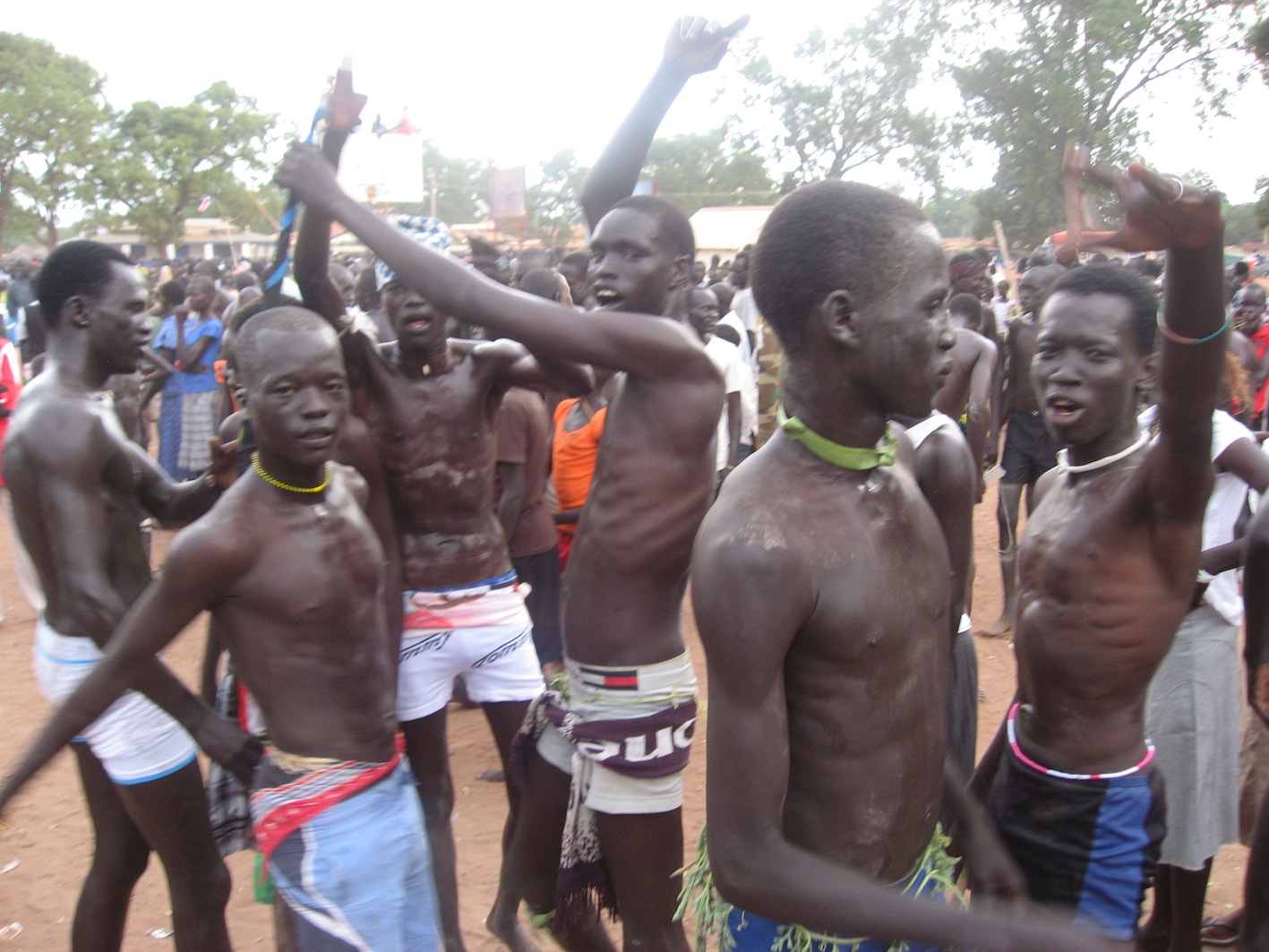
What happens is…groups of young men, wearing boxers, bits of tinsel (left over from the Independence celebrations) and smothered in dust parade into the centre of town. This is meant to give the appearance of people who live in the cattle camp (and it does, pretty well, do this). These groups of men, shouting, sweating a high on testosterone, produce an experience that is not dissimilar to watching a lad’s Friday night out in Newcastle. When they get to Freedom square they start a dance, mostly they are doing one that involves jumping round backwards in a circle, singing and shouting bull names, girls join in too.

After a bit of asking around I discovered that these dances are organised by local students, and they are supposed to be a celebration of Dinka ‘culture’.  It’s a kind of self-mimicry or self-representation. Many of the participants feel quite distant from the ‘cattle culture’ in town, but they find ways to display and venerate it. Even though most people I spoke to thought the technical abilities of the dancers left something to be desired…and they were apparently (though not to me) very obviously not the cattle keepers they were acting as.  A fascinating kind of cultural heritage production.